
Vital Politics: Rethinking Normativity in the Anthropocene (VIPO)
The Vital Politics research project studied how to include the natural world in the justification of political norms, with a special focus on the norms governing democratic decision-making about climate change.
Democratic theory has struggled to respond to the Anthropocene, a new and paradoxical geological epoch in which human activity comes to dominate the Earth System at the same time that nature becomes ever-more resistant to human control. VIPO found resources in the neglected tradition of philosophical vitalism to negotiate this paradoxical condition.
Eschewing the traditional opposition between nature and society, VIPO sought a perspective from which to ground the justification of political norms - understood as shared principles of action - in a larger concern for life itself. To do so, it combined the philosophical practice of genealogy with methods from performance-as-research.
THE PROJECT IS CLOSED
Project period: 2021-2024
Principal Investigator (PI): Lars Tønder
Subproject 1: Norms and Normativity in the Vitalist Tradition
SP1 developed the conceptual tools of vitalist normativity, showing how the entanglements of human beings and the natural environment exhibit a concern for life itself. Drawing upon philosopher of science George Canguilhem’s ideas of biological and social normativity, SP1 clarified the basic conditions under which such a concern becomes possible.
Subproject 2: Vitalism in Action
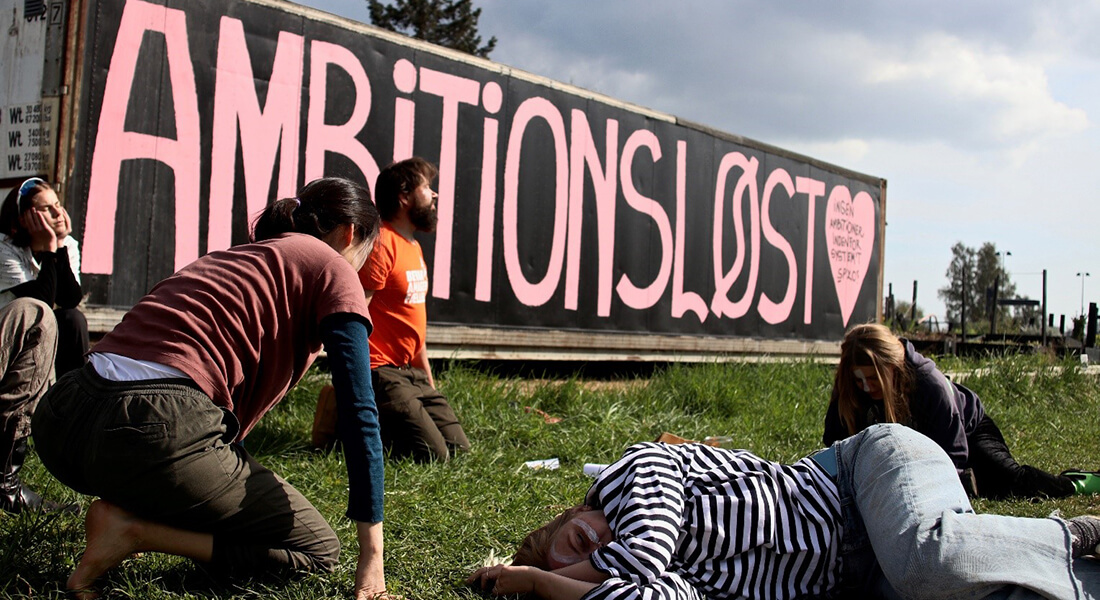
SP2 adopted a performance-based approach to explore how attention to a concern for life can be institutionalised in democratic decision-making processes. In collaboration with local artists and activists, SP2 hosted a 2-day workshop designed to test how a staging of the democratic decision-making process that included nonhuman actors might generate institutional practices committed to effective climate change policies.
Subproject 3: Vitalism, Representative Democracy, and the Politics of Swarming
SP3 situated such institutionalisation within the general theory of representative democracy. Beginning from a new materialist understanding of agency as distributed across human and nonhuman life, SP3 showed how a “politics of swarming,” in which
multiple actors coordinated through decentralised networks of communication, prompted a reconceptualisation of two features of representative democracy: representation and deliberation.
Researchers
This content is temporarily unavailable because the system it is fetched from cannot be reached. The rest of the site works as usual.
Status is available on the operating status page.
Funded by
Vital Politics: Rethinking Normativity in the Anthropocene was funded by the Independent Research Fund Denmark
Project: Vital Politics: Rethinking Normativity in the Anthropocene (VIPO)
Period: 2021-2024
Contact
Lars Tønder
Principal Investigator
Department of Political Science
Mail: lt@ifs.ku.dk
Phone: +45 35 32 04 89